Multi-Agent Systems Just Entered Production. Salesforce Shows Us What That Actually Means.
Salesforce cut 4,000 jobs and AI now handles 50% of customer interactions. 2026 is the year workflows get automated, not just tasks. Here's what it means for your business.
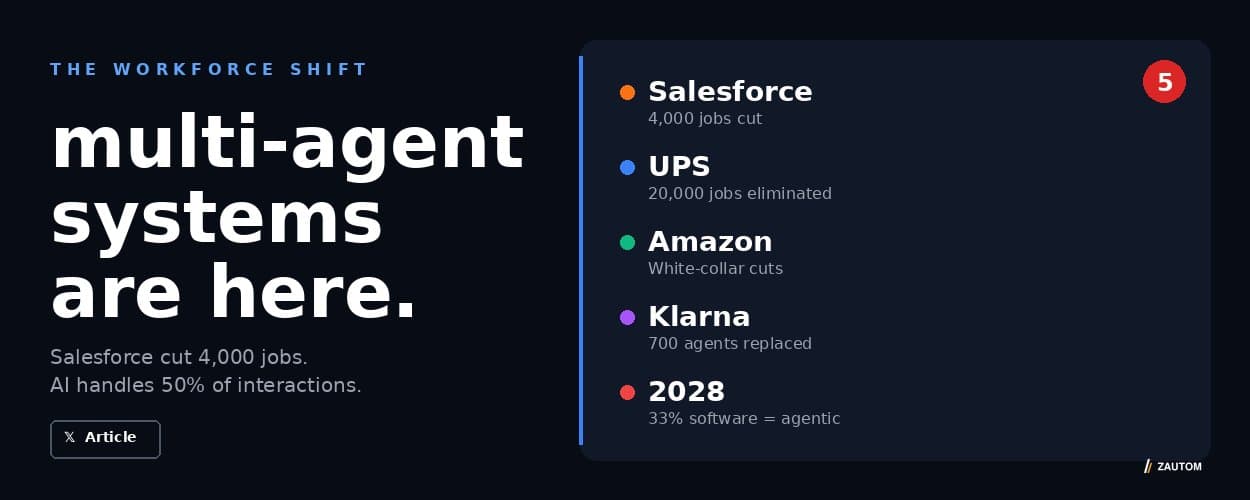
Salesforce cut 4,000 customer service jobs. AI now handles 50% of their customer interactions.
This isn't a pilot program. This isn't a press release about "exploring AI capabilities." This is production.
And it's the clearest signal yet that 2026 is the year multi-agent orchestration stops being a conference talking point and starts being a workforce reality.
I'm seeing this firsthand with my own clients. Three companies I work with started building multi-agent pipelines in Q4 2025. Two of them have already reduced headcount on the teams those pipelines replaced. This isn't theoretical for me — it's what my last six months have looked like.
The Shift Nobody's Talking About
For the past two years, the AI conversation has been about individual agents. Chatbots. Copilots. Assistants that help you do your job faster.
That era is ending.
What's replacing it is multi-agent orchestration — systems where multiple AI agents work together, hand off tasks to each other, and complete entire workflows without human intervention.
Not one agent answering a customer question. A system of agents that:
- Triages the incoming request
- Pulls relevant account data
- Determines the appropriate response
- Escalates edge cases to specialized agents
- Loops in a human only when genuinely necessary
That's what 50% of Salesforce's customer interactions look like now.
Why Multi-Agent Is Different
Solo agents automate tasks. Multi-agent systems automate workflows.
That distinction matters because workflows are what jobs are made of.
When you automate a task, you make someone faster. When you automate a workflow, you make someone optional.
| | Solo Agent | Multi-Agent System | |---|---|---| | Scope | Single task | End-to-end workflow | | Human role | User directing the agent | Human as supervisor, not operator | | Failure mode | One task done wrong = isolated failure | Cascading failures across a pipeline | | Result | Productivity gain | Headcount reduction |
Here's how the progression has played out:
2023–2024: Task Automation AI helps draft emails, summarize documents, suggest code completions. Result: individual productivity gains.
2025: Workflow Assistance AI handles end-to-end processes with human oversight. AI agents start specializing by function. Result: teams do more with less.
2026: Workflow Automation Multi-agent systems complete processes autonomously. Humans shift from doers to supervisors. Result: headcount reduction.
Salesforce isn't an outlier. They're just first to say it out loud.
The Numbers Behind the Noise
Let's be specific about what's happening:
- Salesforce: 4,000 jobs cut, AI handles 50% of interactions
- UPS: 20,000 jobs eliminated as part of broader restructuring that included AI-optimized logistics
- Amazon: Tens of thousands of white-collar roles trimmed across multiple rounds of cuts, with AI cited as a factor in operational efficiency gains
- Klarna: AI now does the work of 700 customer service agents
A note on these numbers: enterprise layoffs are always multi-causal. UPS was dealing with volume declines. Amazon was correcting pandemic-era overhiring. But in every case, AI capabilities were explicitly cited as enabling the company to operate with fewer people. The pattern is consistent even if the attribution isn't clean.
These aren't startups experimenting. These are enterprise deployments at scale.
Gartner predicts 33% of enterprise software will include agentic AI by 2028, up from less than 1% in 2024. That's not a trend. That's a structural shift in how companies operate.
What Multi-Agent Actually Requires
Here's where most of the AI hype falls apart: multi-agent orchestration is genuinely hard to build.
It's not "connect a few APIs and let the agents figure it out."
I'll give you a real example. One of my clients — a B2B SaaS company with around 200 employees — wanted to automate their lead enrichment pipeline. What used to take a team of eight people doing manual data entry and CRM hygiene now runs on a three-agent pipeline: one agent ingests and normalizes inbound data, a second enriches it against external sources, and a third scores and routes leads to the right sales rep.
They're down to two people overseeing the system.
But getting there took three months of workflow mapping, data cleanup, and failure testing before a single agent went live.
Production multi-agent systems require:
1. Workflow Architecture
Someone has to map every decision point, every handoff, every edge case. Agents don't improvise well. They execute well when the paths are clear.
2. Data Infrastructure
Multi-agent systems are only as good as the data feeding them. If your CRM is a mess, your agents will confidently make wrong decisions at scale.
3. Monitoring and Observability
When one agent fails, it can cascade. You need systems that catch silent failures before they compound. Most companies don't have this.
4. Governance and Compliance
Who's responsible when an agent makes a bad call? How do you audit decisions made by a system of autonomous actors? These questions don't have clean answers yet.
5. Human-in-the-Loop Design
The best multi-agent systems know when to escalate. Designing those boundaries is more art than science.
This is why Gartner also predicts 40% of agentic AI projects will be canceled by 2027. The technology works. The implementation is where companies fail.
Two Paths Forward
If you're watching this unfold, you have two options:
Path 1: Be the one building these systems
Multi-agent orchestration creates massive demand for people who can:
- Design workflow architectures
- Build and maintain data pipelines that feed agents
- Implement monitoring and governance frameworks
- Bridge the gap between what AI can do and what businesses need
This is skilled work. It's not going to be automated anytime soon because it requires understanding both the technology and the business context.
Path 2: Be in a role that requires what agents can't do
Agents are terrible at:
- Navigating ambiguity and politics
- Building genuine relationships
- Making judgment calls in novel situations
- Understanding context that isn't in the data
The roles that survive aren't the ones that are "too complex for AI." They're the ones that require capabilities AI fundamentally lacks — not today, but structurally.
The Real Question
Everyone's debating whether AI will take jobs. That's the wrong question.
The right question is: Are you building the systems, or are you being replaced by them?
Salesforce didn't announce they were "exploring multi-agent capabilities." They announced 4,000 people are gone and AI handles half the work.
That's not a pilot. That's production.
And production is where the jobs disappear.
The shift from solo agents to multi-agent systems isn't coming. It's here. The companies figuring out how to build, deploy, and govern these systems will have advantages their competitors can't easily replicate.
The question isn't whether multi-agent automation will reach your industry. It's which side of the equation you'll be on when it does.
Is Your Business Ready for AI Automation?
Most companies aren't. They're chasing multi-agent hype while their data infrastructure is held together with Google Sheets and prayers.
If you're serious about building systems that can actually support what's coming — whether that's multi-agent orchestration, workflow automation, or just getting your pipelines production-grade — take the readiness assessment or reach out directly. Happy to talk through what it actually takes.